![A logo for a music site with a focus on originality, blending elements of the past, present, and future. The design should embody a sense of timelessness and innovation, capturing the essence of the site's unique sound and vision. The logo should incorporate the capital letter V that reflects movement and energy and should have the word VEKTUR under it. [The logo should exude a modern and sleek aesthetic] [while hinting at a retro vibe].](https://vektur.band/wp-content/uploads/2024/06/img-ugo6iz1ejhqy9vejwtlfuogx.png)
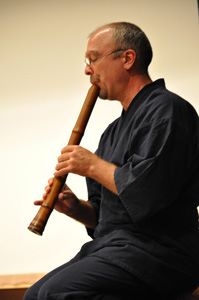
I’ve been involved in the life-long learning process of achieving some understanding and competence in playing the Japanese bamboo flute called the shakuhachi. In fact, at this point in time, I’ve been at it for 36 years.
The process of learning to play the shakuhachi comes from an oral tradition that dates back several hundred years, though the school that I belong to – Kinko-ryu – is closer to 300 years since its inception. My local guild (Wakanakai) is about 150 years old and focuses on secular, ensemble music called ‘sankyoku’ which refers to the ensemble format of shamisen (3-string lute), koto (13 to 25 string zither), and shakuhachi.
By oral tradition, I mean that the shakuhachi student typically sits seiza (as I am in the above picture) across from the master with a spread of music notation between them.
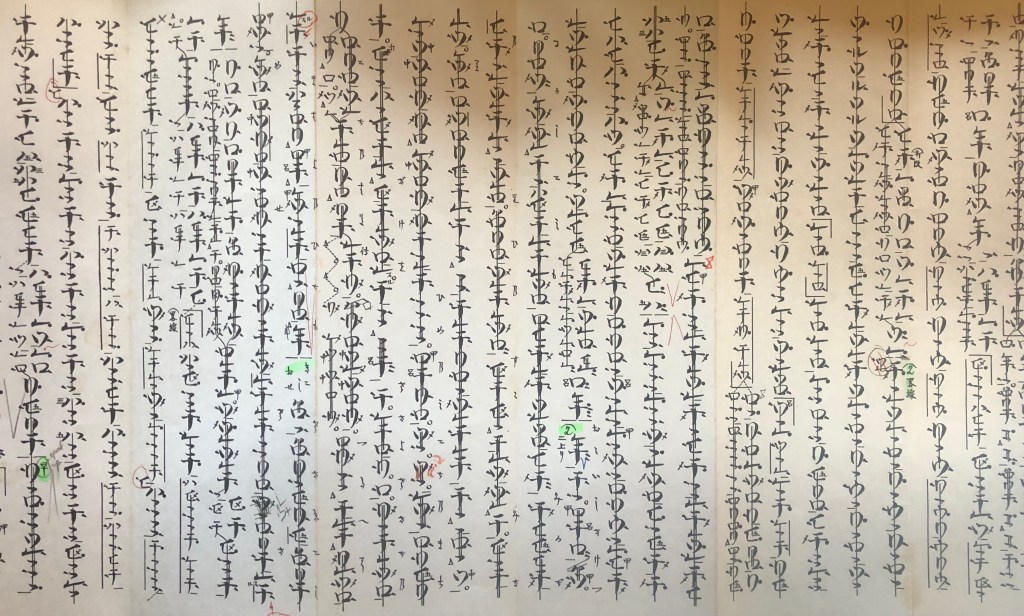
The teacher plays a passage, and the student tries to emulate the peculiarities of the teacher. Typically very little speaking happens at this time. At the end of a session, the teacher might remark something like, ” Keep on trying. See you next time.”
This process befuddled me at first as I had many questions. But my sensei could not speak English, and I could not speak Japanese, such as it was. After time, especially as I started performing in public with many very advanced players, I became more familiar with the music that I was playing, though it had no semblance to any kind of music that I was familiar with.
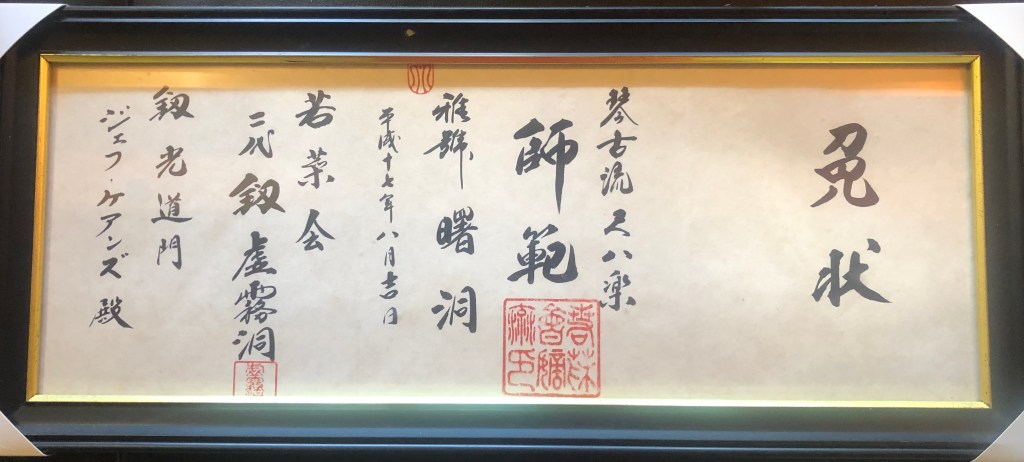
I pushed on and one day after probably 10 years of playing and performing both traditionally, and contemporarily in my own projects, not to mention recording and publishing albums, I asked my sensei when, if ever, he would issue me my master’s license that would not only be recognition of my level of proficiency, but would give me the right to take students and be called a teacher within the shakuhachi community. His answer through me aback, ” I didn’t think you cared about that. You could have had it years ago!”
I was then issued my Shihan (master) license with the name Shodou (曙 洞), which is a derivation of my sensei’s name (KyomuDOU) and my previous introductory name to the guild, HoSHOU.
 Vektur
Leave a comment